
UK government and funder policies require researchers to publish their work Open Access. In 2014 a new requirement came into place which meant that all research articles which had been accepted for publication by a journal should be deposited in an institutional repository at the point of publication, and made available open access.
The brief was to help University of Cambridge researchers navigate the complex and rapidly changing publishing landscape and comply with policy requirements.

The challenge
Before I started on the project some user research had already been completed, to better understand the experience of academic publishing. A key findings was that academic researchers were not in touch with their institution at the point of publishing their work in a journal. And that the process of getting an article accepted for publication could be quite stressful. Therefore we knew it was going to be extremely challenging to persuade researchers to deposit a copy of what was known as their ‘author accepted manuscript’ in an institutional repository.
We wanted to better understand the diversity and pressure of academic roles, which could include running a research group, applying for grants, conducting research, writing papers, maintaining external collaborations, lecturing, supervision and pastoral care for students.
My role as user researcher
I led an ethnographic user research study, shadowing 10 academics for 2 days each. I planned and carried out the research collaboratively with two service designers. I created a template to capture our notes and we used small cameras to record images throughout the day.
I created ‘day in the life’ visuals and a research report, to communicate insights to the team and stakeholders.

I found that academics who run research groups were in effect running a small business within the University. They were extremely pressured with several different responsibilties, from applying for funding, doing their research (often with external collaborators), publishing their findings and recruiting and supervising postdoctoral students to course design, lecturing and providing pastoral care to undergraduate students as a tutor.
I identified several opportunities for the University to support academics. For example services that could save them time, provision of support, training and guidance on running a research group and shared technologies and services for managing their research process.
I created a grant funding application experience map to illustrate the experience of applying for grant funding as this was a potential area for future service design.
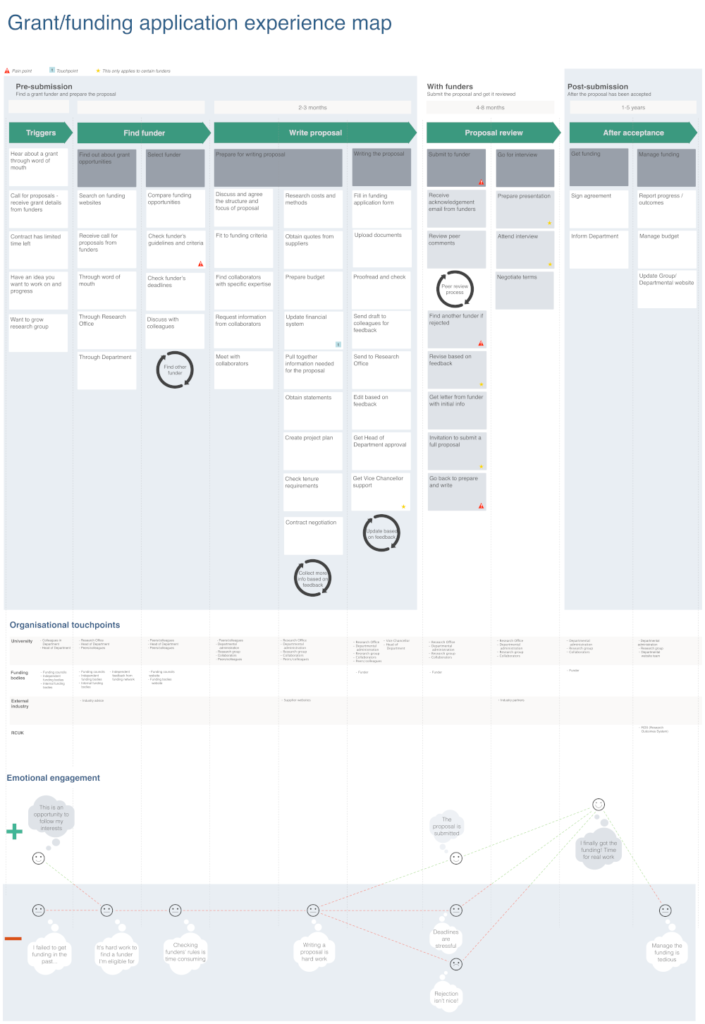
All of my research outputs (with the exception of the research report) are available to view in the academic experience collection in the University reposistory.
My role as Product Manager and Service Designer
I led a team of 3 service designers and 3 developers to develop the open access service. I started by getting the team to define the problem to be solved using an adapted Lean UX canvas.

As design of the new service got underway, I created a service blueprint to help the team conceptualise the service.
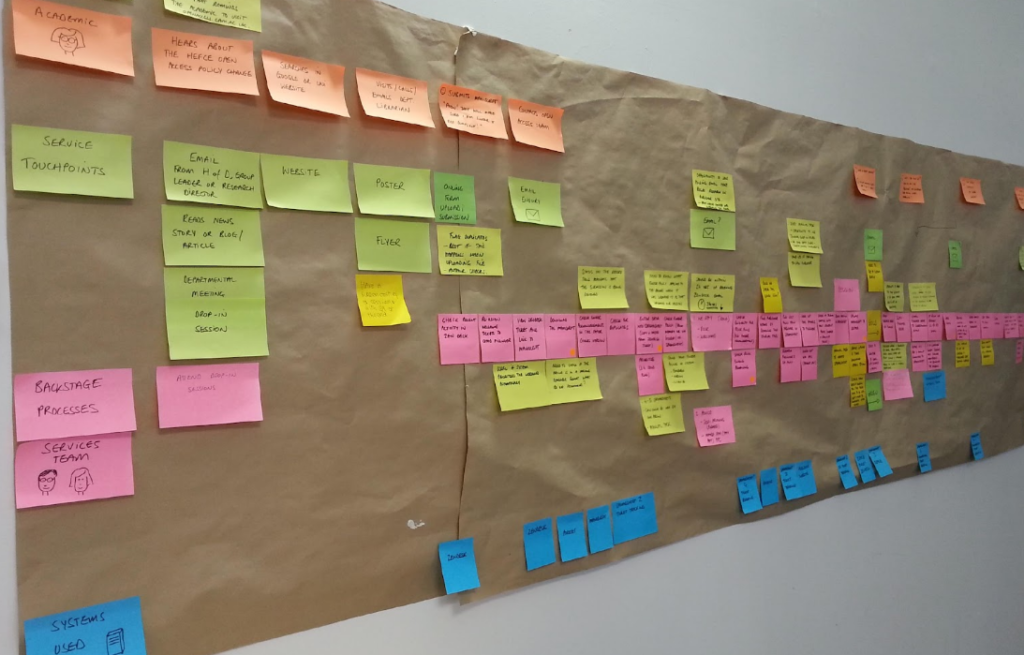
I facilitated design studios and established ‘User Thursday’ to ensure regular testing of the designs. The design team used paper prototypes to rapidly iterate on the design.
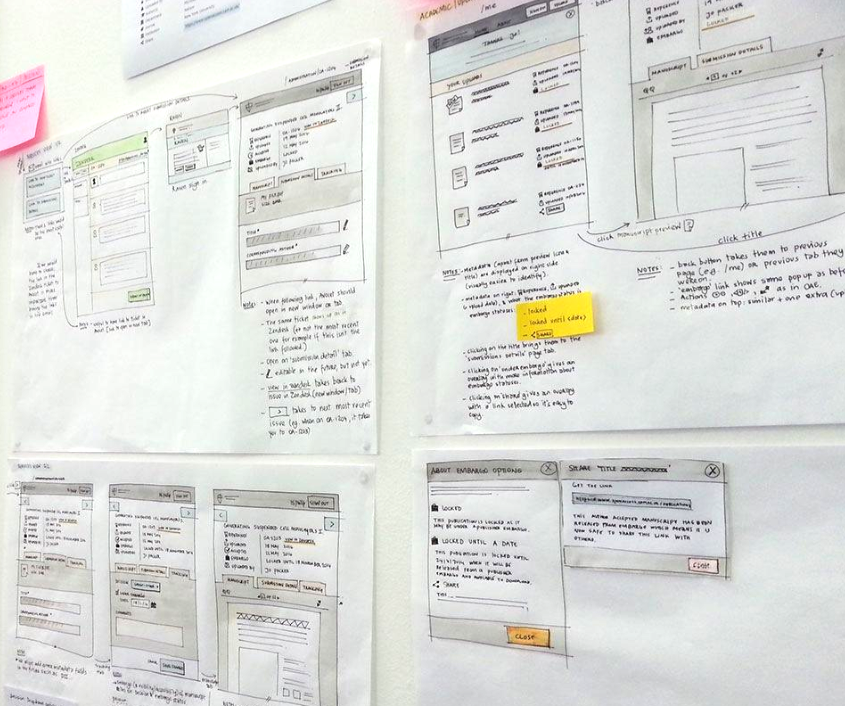
During development we continued testing designs iteratively with academic researchers.
I helped establish a new Open Access team to operationalise the service provided by the University Library team. This included configuring ZenDesk to manage support tickets from researchers. Once the service was operational I worked with the team to optimise their processes and services based on user feedback and data.
I was responsible for outreach to the 20 University departments who had the highest research output, presenting to senior academics. I also presented to librarians and departmental administrators (who had responsibility for open access) and wrote articles for University publications such as CULIB (Cambridge University Libraries Bulletin).

Outcomes
In May 2014 we launched an Open Access pilot service which ensured the University complied with new policy requirements. Some academics in STEM disciplines like Physics, Maths and Astronomy were initially resistant to having to use the service to deposit their manuscripts. They were already posting their articles as preprints to a preprint server and didn’t like the duplication of effort. I took time to listen to their concerns and did some research into the preprint sever and found that the metadata attached to the articles would not meet the UK Government policy requirements. I liaised with the University in the US who managed the preprint server and explained the situation. As it was an issue only affecting UK researchers, it was not a high priority on their roadmap. By listening, responding, communicating clearly and adapting the service based on feedback from academic researchers I persuaded resistant stakeholders to get on board and use the service despite their initial concerns.